How Do Cooler Bags Work: Ultimate Guide from Industry Experts
Are you looking for the right cooler bags for your business project, but worried about making the wrong decision when faced with such a wide variety of options because you’re unfamiliar with how cooler bags work? Whether your project involves procurement for a logistics company or retail sales on supermarket shelves, your customers will inevitably ask about the performance of these cooler bags. If you provide incorrect explanations or are unable to answer their questions because you don’t understand how they work, it will seriously undermine your professionalism in the eyes of your customers and cause you to lose orders. In this article, I’ll teach you how cooler bags maintain low temperatures, their operating principles, and tips for use (informing customers in advance can reduce after-sales issues).
(Don’t be tempted to scroll past just yet when you see all this dense text. I understand that technical information can often be dry and boring, so I’ve used conversational language throughout to make these technical concepts simple and easy to understand. Your project clients need this kind of explanation, too, don’t they?)
Quick Conclusion: How Do Cooler Bags Keep Food Cold?
Simply put, cooler bags work by focusing entirely on thermal insulation. In fact, cooler bags themselves do not generate cold (except for electric models); they simply use insulating materials and a tight seal to slow down the transfer of heat in and out, thereby maintaining the internal temperature and slowing heat loss—just as you feel cooler when using a parasol in the sun. To make it easier to understand, here’s a quick summary:
| Heat‑Insulation | Explanation |
| Conduction | Heat transfer through solid media. For example, a sun‑exposed metal railing feels burning‑hot in summer, while a thick foam board does not. The foam padding inside cooler bags works like this foam board, blocking external heat from seeping through the bag fabric. |
| Convection | Heat transfer via moving air or fluids. Similar to repeatedly opening a refrigerator door: warm air flows in and quickly warms up the contents. If the zipper on a cooler bag is not fully closed, hot air keeps seeping in, causing ice packs to melt much faster. |
| Radiation | Heat transfer via electromagnetic waves. Sunlight is a typical example. Silver sun‑shades reflect solar rays instead of absorbing heat. The silver aluminum‑foil lining inside cooler bags reflects external radiant heat, preventing the bag interior from heating up from solar radiation. |
Cooler bags utilize these principles, using a multi-layered structure to block heat transfer—effectively preventing external heat from penetrating and slowing the loss of internal cold air.
When a client on your project asks how these cooler bags work to keep the contents cold, you can start by explaining the principles using technical terms like “conduction, convection, and radiation.” If the client finds this too complex, follow up with examples to illustrate the principles. This approach will help you build trust through your expertise and secure the order.
How the Insulation in Cooler Bags Works
Once your project clients have learned how Cooler Bags work, the next step is usually for them to ask, “So, what specific insulation materials are used in Cooler Bags? What are the differences in performance and cost between them?” Therefore, you must also be familiar with and understand the details regarding insulation materials. I’ve listed the most commonly used insulation materials for Cooler Bags and explained their advantages and characteristics:
Table of Characteristics of Insulation Materials for Cooler Bags
The following table outlines the characteristics and typical applications of common insulation materials used in cooler bags:
| Material | R‑Value (per‑inch thermal resistance) | Density | Typical Weight (5 mm thickness) | Features |
| EPE Pearl Foam | R1.3‑2.0 | 18‑35 kg/m³ | 90‑175 g/m² | Standard closed‑cell foam; lightweight, low‑cost, moderate compression resistance. Widely used for food‑delivery thermal bags. |
| XPE / IXPE Cross‑Linked Pearl Foam | R1.8‑2.5 | 30‑60 kg/m³ | 150‑300 g/m² | Fine dense cell structure; better rebound & fatigue resistance than EPE, lower heat conduction. Common for camping cooler bags & baby bottle totes; resists collapse with long‑term use. |
| XPE + Aluminum‑Foil Composite | R2.2‑3.0 | 35‑65 kg/m³ (including aluminum foil) | 180‑330 g/m² | Foam blocks conductive heat; aluminum foil reflects thermal radiation for upgraded overall insulation. Silver‑lined cooler bags deliver superior cold retention under direct outdoor sunlight. |
| PU Polyurethane Foam | R3.0‑4.0 | 24‑48 kg/m³ | 120‑240 g/m² | Closed‑cell structure with lowest thermal‑conductivity and top‑tier insulation; less flexible, higher cost. Used for refrigerator inner liners. |
| EVA High‑Resilience Closed‑Cell Foam | R2.0-2.8 | 45-80 kg/m³ | 220‑400 g/m² | Excellent rebound and compression resistance; high‑density, non‑toxic & odor‑free, waterproof and shock‑absorbent. Top choice for premium cooler bag bases, die‑cut molded layers and rigid‑style insulated bags. |
| Double‑Sided Aluminum‑Foil Bubble Pad | R11-1.6 | 15-30 kg/m³ | 80‑150 g/m² | Bubble cavities paired with high‑reflective aluminum film; lightweight and highly foldable. Primarily used for cold‑chain inner liners for fresh‑food e‑commerce and low‑cost foldable thermal pouches. |
| rPET Recycled Eco‑Friendly Insulation Batting | R1.5-2.2 | 20-50 kg/m³ | 100‑300 g/m² | Compressed fibers made from recycled plastic bottles, GRS‑certified. Used for corporate custom gifts and branded cooler bags focused on ESG & sustainability values. |
Bar Chart of R-Values for Insulation Materials in Cooler Bags
Here are examples of the R-value (thermal resistance) ranges for each type of material, which will help you see the differences more clearly:
Explanation of How Insulation Materials in Cooler Bags Work:
Now that we’ve covered the properties and R-values of several common insulation materials, let’s take a look at how they work to slow down heat transfer (this topic is a bit advanced, so I’ll do my best to explain it in simple terms).
| Material | Working Principle |
| EPE Pearl Foam | Technical: Closed‑cell bubble cavities trap static air to suppress solid‑state heat conduction and reduce heat penetration into the bag.Layman’s terms: Much like down jackets rely on trapped lofty air to block cold, EPE pearl foam uses countless tiny air bubbles to create thermal‑insulating cushions. |
| XPE / IXPE Cross‑Linked Pearl Foam | Technical: Fine‑tuned cross‑linked bubble structure with tiny closed air cells that further cut heat conduction and prevent the insulation layer from collapsing under pressure.Layman’s terms: Its tighter structure resists crushing under heavy weight or foot traffic, so cold‑retention performance does not fail. |
| XPE + Aluminum‑Foil Composite | Technical: Foam blocks conductive heat transfer; aluminum foil reflects thermal radiation. Dual‑action barrier against both conductive and radiant heat sources.Layman’s terms: It is like adding an automotive sunshade to your cooler bag, bouncing radiant heat from sunlight away. |
| PU Polyurethane Foam | Technical: Ultra‑tight closed‑cell construction with excellent air tightness and extremely low thermal‑conductivity, maximizing blockage of solid‑conducted heat.Layman’s terms: A top‑tier insulation material comparable to foam inner liners for household refrigerators, locking external heat out. |
| EVA High‑Resilience Closed‑Cell Foam | Technical: High‑density closed‑cell cavities deliver thermal insulation via trapped internal air; the structure resists deformation under compression.Layman’s terms: It combines insulation with sneaker‑midsole‑style springiness. It holds temperature and stands up to heavy pressure without warping. |
| Double‑Sided Aluminum‑Foil Bubble Pad | Technical: Bubble cavities trap air to resist conduction; double‑sided aluminum foil reflects thermal radiation. Two‑fold effect reduces incoming heat.Layman’s terms: A “bubble film plus double‑sided heat shield” combo — it locks cold inside while reflecting external heat away. |
| rPET Recycled Eco‑Friendly Insulation Batting | Technical: Gaps formed by stacked recycled fiber trap static air for thermal insulation.Layman’s terms: Works similarly to wool felt. Interlocked recycled‑fiber strands trap heat within micro‑pores. |
Tip: When customizing cooler bags for your project, if you’re looking for longer-lasting cooling performance, keep this key principle in mind: the thicker the insulation layer, the longer the items inside will stay cool. Some soft-sided cooler bags, when equipped with a thickened EPE insulation layer and used with ice packs, can keep items cool for over 24 hours.
What are the different types of cooler bags?
When choosing cooler bags for your project, the main factors to consider are the intended use and the duration of cooling. Here, I’ll list several common categories of cooler bags and explain their features and suitable applications (since each category includes many specific subtypes, I’ll primarily use general models from each category as examples).
soft sided cooler bag
Soft-sided cooler bags are the most popular category on the market; you can find them on store shelves and at beverage stands in almost any shopping mall. Their most distinctive feature is that they lack a rigid outer shell and rely on an internal foam insulation layer to keep contents cool. They are typically made of polyester or Oxford fabric and can be folded for storage.
- Cooling Duration: Standard model: 4–8 hours; Premium model (featuring XPE + aluminum foil composite material and a sealed, waterproof zipper): up to 12–24 hours
- Ideal Uses: Outdoor picnics, food delivery, breast milk storage for mothers and infants, promotional giveaways at supermarkets, and brand event gifts
- Capacity Range: 3L–30L
- Portability: Excellent; foldable and compressible for storage; equipped with a carrying handle and shoulder strap; lightweight
Note: Without a rigid outer shell for support, the bag may deform when loaded with heavy items. To address this, a removable PE/PP reinforcement panel can be added to the bottom during use. This not only maintains the bag’s structure but also improves load-bearing capacity. When not in use, the panel can be removed, and the bag can be folded for storage.
Coca-Cola placed a large custom order for soft-sided cooler bags featuring the brand’s signature red color and classic logo to use at summer music festivals and outdoor beach parties. These bags served as giveaways (GWP) at the events, used to hold chilled canned sodas and promotional merchandise.
Hard-Sided Coolers
Hard-sided coolers feature a one-piece shell made of rigid materials such as EVA, PP, or ABS, with an internal composite insulation foam layer. The rigid shell provides physical protection, ensuring that—unlike soft-sided cooler bags—they will not deform from stacking or heavy pressure.
- Cooling Duration: Basic models: 8–16 hours; High-end, airtight models: up to 24–36 hours
- Ideal Uses: Fishing, long-distance road trips, outdoor camping, short-distance cold chain storage of materials requiring impact and pressure resistance, and premium brand gift sets
- Capacity range: 10L–50L
- Portability: Average; cannot be folded or compressed; relatively heavy; larger models typically come equipped with handles or wheels for easy transport
Note: The hard shell takes up more storage and shipping space, and the overall cost is higher than that of soft-sided insulated bags
For outdoor fishing tournaments, Yeti custom-manufactured a large number of hard-sided coolers to be used as prizes. These coolers are designed to hold iced drinks and freshly caught fish, and their hard-shell construction protects them from outdoor bumps and impacts while maintaining a cold internal temperature for extended periods.
food cooler bag
These food cooler bags are specifically designed for storing meals and bento boxes. Most feature a square, short, and wide shape, with interior dimensions tailored to fit meal containers and bento boxes. The outer fabric is primarily made of oil-resistant, easy-to-wipe materials, while the inner lining commonly uses TPU or aluminum-coated PEVA, all of which meet food contact safety standards (EU 10/2011, FDA food contact grade).
- Cooling Duration: Basic models: 3–6 hours; premium, thickened, insulated models: up to 7–12 hours
- Ideal Uses: Carrying lunch boxes for office workers, children’s school lunches, takeout and fast-food delivery, packing food for picnics, corporate employee benefits and gifts
- Capacity Range: 4L–22L
- Portability: Good; most models can be lightly folded and come with a carrying handle or short shoulder strap. Their size is designed to fit meal containers, making them easy to store in backpacks or car storage compartments.
Note: Do not store liquid foods with broth or sauces for extended periods to prevent leakage from damaging the insulation layer.
As part of promotional campaigns at select brick-and-mortar stores in Europe and the U.S., Subway has created custom food cooler bags to give away to customers who spend a certain amount. These bags are designed to hold takeout sandwiches and salads, keeping the food cool and fresh and enhancing the customer experience.
travel cooler bag
This portable insulated bag is specifically designed for travel and on-the-go scenarios. The travel cooler bag features a sleek, slim profile that fits comfortably into your travel storage routine, and is lightweight, tear-resistant, and abrasion-resistant. The outer layer is primarily made of high-density, abrasion-resistant Oxford fabric, which is water-resistant and stain-resistant, making it ideal for bumpy outdoor journeys.
- Cooling Duration: Standard model: 6–10 hours; Premium thickened, airtight model: up to 12–20 hours
- Ideal for: Road trips, short getaways, long-distance travel with children, keeping food cool during outdoor hikes, and as promotional gifts for travel brands
- Capacity Range: 6L–25L
- Portability: Excellent—lightweight, foldable, and compact enough to save space in your luggage. Comes standard with an adjustable long shoulder strap and a carry handle for dual-carry modes, making it ideal for on-the-go use.
Note: Although designed for travel, this product is not suitable for prolonged exposure to direct sunlight or high-intensity outdoor cooling needs. Additionally, when storing items during your trip, take care to avoid sharp objects that could puncture or scratch the inner lining.
As part of its North American summer travel promotion, Dollarama is offering a custom travel cooler bag as a free gift with qualifying purchases in-store. Designed specifically for families on short trips and road trips, it’s perfect for storing ice-cold water, fruit, and portable snacks. Lightweight, durable, and easy to pack, it significantly enhances the travel experience.
portable cooler bag
This is the most versatile model among all insulated bag categories. With a simple, slim design and compact size, its soft fabric allows for easy folding and compression for storage. It’s suitable for any occasion and takes up minimal storage space. The outer layer of the portable cooler bag is made of lightweight, abrasion-resistant polyester fabric that’s tear-resistant and easy to clean, making it ideal for frequent daily use.
- Cooling Duration: Standard model: 4–7 hours; Premium model with thickened lining: up to 8–14 hours
- Ideal for: Daily commutes, short shopping trips, outdoor activities, small picnics, keeping bubble tea and other beverages cold, and as promotional giveaways for store sales
- Capacity range: 2L–18L
- Portability: Excellent—extremely lightweight, folds completely flat for storage, and features either a thin shoulder strap or a carry handle, allowing it to fit directly into backpacks, tote bags, or car storage compartments
Note: Since this model prioritizes an ultra-lightweight design, its internal insulation layer is relatively thin. Therefore, it is not suitable for extremely long-term, extreme cold retention, nor is it suitable for carrying extremely heavy or hard items with sharp edges.
During Walmart’s summer outdoor promotional campaign in North America, the company had large quantities of affordable, custom-made portable cooler bags produced as giveaways to attract customers. Designed for everyday use, these bags are specifically intended to hold cold drinks, snacks, and fruit. Thanks to their lightweight, portable design and space-saving features, they became the most widely distributed insulated bags at street events.
cooler bag with speakers
A special cooler bag that integrates a rechargeable Bluetooth speaker module, combining beverage cooling with outdoor audio playback. The outer layer is typically made of abrasion-resistant, waterproof polyester fabric; the speaker unit can be mounted on the outside of the bag, while the interior still features a standard insulated lining to maintain cold temperatures.
- Cooling duration: Standard model: 5–9 hours; High-end, thickened-insulation model: up to 10–18 hours
- Ideal for: Beach parties, outdoor music festivals, tailgate parties, backyard picnics, promotional gifts for beverage brands, and giveaways at sporting events
- Capacity range: 8L–26L
- Portability: Good; features a top handle and an adjustable shoulder strap. The speaker module has its own battery, which slightly increases the overall weight; some soft-sided models can be folded slightly.
Note: The electronic components inside the “cooler bag with speakers” must be kept dry during use to prevent damage.
At summer beach parties and sports events across North America, Bud Light has customized large quantities of cooler bags with built-in speakers as promotional giveaways. These bags are used to store canned beer and cold drinks, while the Bluetooth speakers play music on-site to set the party mood, making them a very popular promotional item among beverage brands.
Summary of Differences Among Various Types of Cooler Bags
By now, you should have a general understanding of the different types of cooler bags, and based on the usage scenario guidelines, you should know how to choose the right one for your project. It’s possible that more than one type of cooler bag fits your project’s usage scenario, and you’re currently trying to decide which one is more suitable. So, I’ve put together a comparison table to help you make an informed decision for your project:
| Cooler Bag Category | Best‑Suited For | Capacity Range | Cooling Duration | Portability |
| Soft‑Sided Cooler Bag | Picnics, food delivery, brand gift‑with‑purchase promotions | 3L‑30L | Standard: 4‑8 h; Premium: 12‑24 h | Excellent; foldable and compressible |
| Hard‑Sided Coolers | Fishing, road‑trip car camping, high‑end pressure‑resistant gifts | 10L‑50L | Base model: 8‑16 h; Premium: 24‑36 h | Fair; non‑foldable, relatively heavy |
| Food Cooler Bag | Office worker lunches, kids’ packed meals, corporate employee perks | 4L‑22L | Base model: 3‑6 h; Premium: 7‑12 h | Good; supports light folding |
| Travel Cooler Bag | Road trips, short excursions, family outings | 6L‑25L | Base model: 6‑10 h; Premium: 12‑20 h | Excellent; foldable to fit inside luggage |
| Portable Cooler Bag | Daily outings, short trips, low‑cost promotional giveaways | 2L‑18L | Base model: 4‑7 h; Premium: 8‑14 h | Outstanding; can be fully flattened for storage |
| Cooler Bag With Speakers | Beach parties, music festivals, themed‑event promotional gifts | 8L‑26L | Base model: 5‑9 h; Premium: 10‑18 h | Good; light folding possible; speakers add extra weight |
Materials and Manufacturing Standards for Cooler Bags
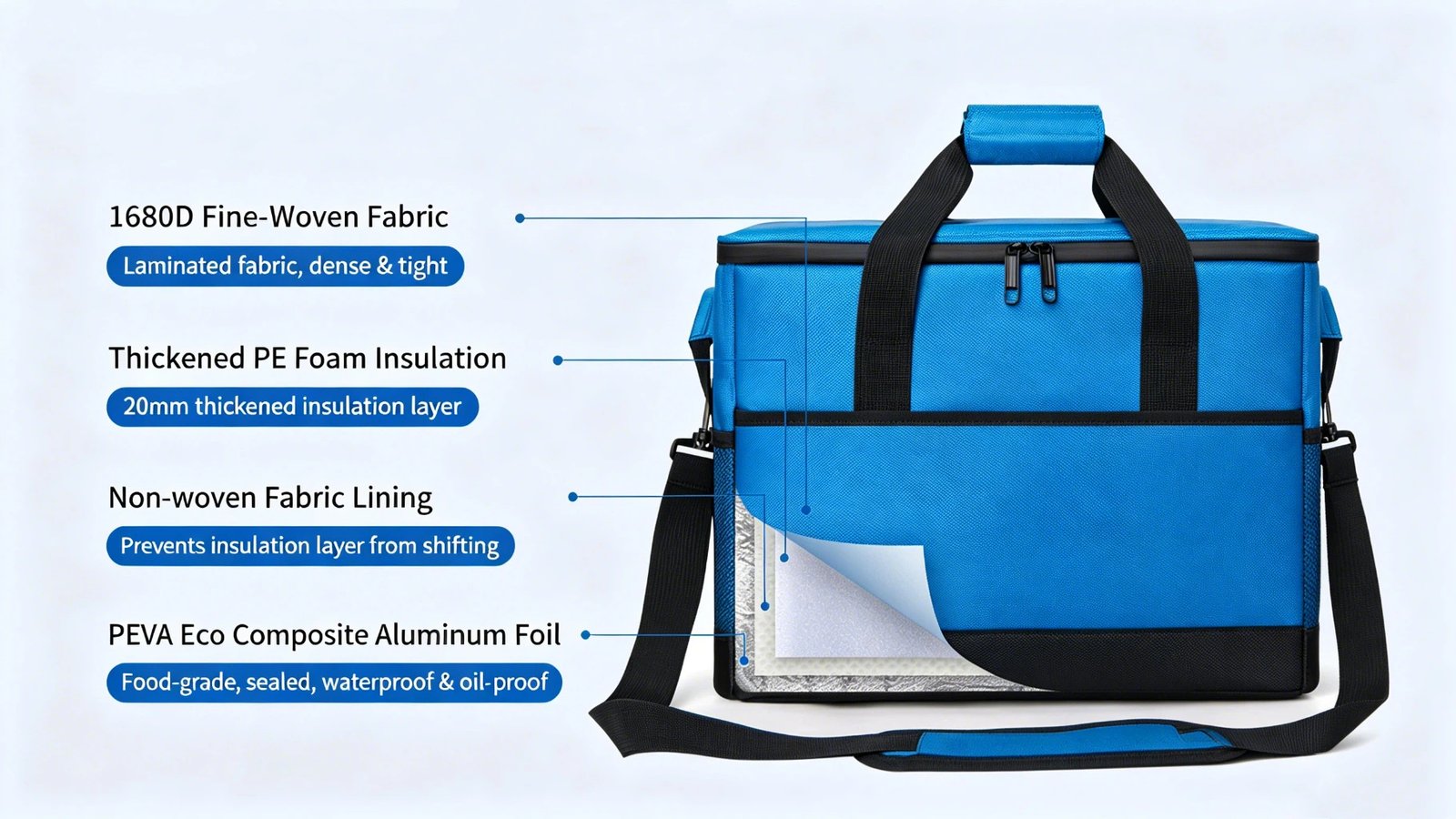
The materials used in cooler bags aren’t limited to the insulation layer mentioned above; they’re primarily made from a combination of various materials to enhance thermal performance and adaptability to different scenarios. Here, I’ll categorize the materials into three types, and now I’ll walk you through the characteristics and manufacturing standards of each layer:
Housing
It directly determines the case’s wear resistance, stain resistance, water resistance, and the quality of the printed design; first and foremost, the outer shell itself plays almost no role in maintaining cold temperatures—its primary function is to protect the inner thermal insulation layer from wear and tear.
Main materials:
- Polyester: Enhances the UV resistance of cooler bags; 600D–1680D Oxford polyester is commonly used in production, with 600D typically used for promotional giveaways and 1200D–1680D for high-strength outdoor models
- Nylon: Enhances the tear resistance of cooler bags, is lighter in weight, and has a soft feel; 420D–840D nylon is commonly used in production, primarily for high-end, lightweight travel insulated bags; the material is more expensive than polyester
- Canvas: Suitable for large-area printing on the surface when manufacturing cooler bags; Common specifications include 12–16 oz canvas, which is relatively heavy and has poor water resistance; it is mostly used for everyday casual and retail-oriented insulated bags
- PVC: Divided into rigid and flexible PVC, it offers outstanding water resistance when used in cooler bags, with a smooth surface that is easy to wipe clean; flexible PVC is often used for budget-friendly gift items, while rigid PVC is used for the outer shells of hard-shell insulated bags, though it tends to become brittle in low-temperature environments
- EVA: The core shell material for hard-shell cooler bags; it can be molded into various shapes
- TPU: Often used in high-end roll-top waterproof insulated cooler bags; its cost is significantly higher than that of polyester or nylon; the material is inherently flexible, hydrolysis-resistant, low-temperature-resistant, and offers excellent waterproof performance
| Material | Features | Heat Conduction | Abrasion Resistance | Water Resistance |
| Polyester (Oxford Fabric) | Cost‑effective, UV‑resistant, color‑fast; most widely used on the market | Low | Good‑Excellent | Waterproof with coating treatment |
| Nylon | Lightweight, high tear strength, soft hand‑feel | Low | Excellent | Waterproof with coating treatment |
| Canvas | Vintage texture, great printing performance | Low | Good | Not inherently waterproof; extra water‑repellent finish required |
| PVC | Smooth surface, easy to wipe clean | Low | Moderate | Excellent |
| EVA | One‑piece molded, compression‑resistant, shape‑retaining; primary material for hard‑shell coolers | Low | Good | Excellent |
| TPU | Hydrolysis‑resistant, cold‑resistant, flexible waterproof; premium outdoor‑grade option | Low | Excellent | Excellent |
If your project is primarily intended for outdoor use, the abrasion- and tear-resistant properties of a nylon casing would be more suitable. However, for everyday, light-duty use in an office setting, polyester offers better value for money when purchasing in large quantities.
Insulation Layer
The true insulating effect of cooler bags comes mainly from the insulation layer. Typically, the thickness of the insulation layer ranges from 1 inch to 2 inches. Here is a list of commonly used materials for insulation layers and their specifications:
Main Materials:
- EPE: Commonly used at densities of 25–35 kg/m³, primarily for affordable, promotional soft-sided insulated bags.
- XPE: Commonly used at densities of 30–45 kg/m³, widely used for travel and picnic-style insulated bags.
- XPS: Commonly used at densities of 32–40 kg/m³, primarily for hard-sided insulated bags (which cannot be bent).
- PU: Rigid PU is widely used in high-end hard-shell coolers and medical cold chains, while flexible PU is less commonly used in standard soft-sided coolers.
| Material | Features | Insulation Performance | Compression Resistance | Water & Moisture Resistance |
| EPE Pearl Foam | Soft and foldable, low‑cost; widely used for promotional giveaway items | Moderate | Poor; prone to collapse under long‑term pressure | Excellent |
| XPE Cross‑Linked Polyethylene | Good rebound, anti‑collapse; mainstream material for soft‑sided coolers, balanced cost‑performance | Good | Good | Excellent |
| XPS Extruded Polystyrene | Rigid panel material, outstanding thermal insulation | Excellent | Excellent | Excellent |
| PU Polyurethane Foam | Top‑tier insulation performance; mostly used for premium hard‑shell products | Superior | Excellent | Excellent |
Note: For insulation layers of the same thickness, insufficient material density can cause the insulation to fail after repeated compression. When explaining this to your project clients, be sure to provide not only the thickness but also the density specifications.
Lining
The lining is the inner fabric of cooler bags that comes into direct contact with beverages, food, and ice packs. It must prevent condensation from seeping through while also being easy to wipe clean. Because it comes into direct contact with food, it must comply with the requirements of the EU Regulation (EU) No. 10/2011 on plastic materials intended to come into contact with food and the U.S. FDA’s 21 CFR. This requires special attention when customizing and wholesaling cooler bags.
Main Materials:
- Aluminum-coated PEVA: The aluminum coating on the surface reflects thermal radiation; typical thicknesses range from 0.08 to 0.12 mm, meeting the basic food contact standards of EU 10/2011 and FDA 21 CFR.
- TPU film: Resistant to oil stains and hydrolysis; commonly used thicknesses range from 0.10 to 0.20 mm, and it consistently passes EU 10/2011 and FDA 21 CFR food contact testing.
- Aluminum foil PET: Primarily used for low-cost, single-use, short-term promotional insulated bags; Thickness ranges from 0.05 to 0.07 mm; it repels moisture and reflects heat, but cannot consistently meet the long-term food contact requirements of EU 10/2011 and FDA 21 CFR.
- PVC Liner: Waterproof and easy to wipe clean; however, EU Regulation 10/2011 imposes restrictions on PVC for food contact, so it is more suitable for use when storing bottled or canned beverages.
| Material | Features | Water‑Vapor Barrier | Tear Resistance | Food‑Contact Compliance |
| Aluminum‑Coated PEVA | Cost‑effective, reflects thermal radiation; mainstream budget‑grade lining | Good | Moderate | Complies with EU 10/2011 and FDA 21 CFR |
| TPU Film | Oil‑resistant and hydrolysis‑resistant, sturdy & durable, easy to wipe clean | Excellent | Excellent | Consistently meets EU 10/2011 and FDA 21 CFR |
| Aluminum‑Foil PET | Light‑weight and ultra‑low‑cost | Moderate | Poor; highly prone to tearing | Cannot reliably satisfy EU 10/2011 and FDA 21 CFR; not recommended for direct food contact |
| PVC Lining | Great waterproof performance, easy to clean | Excellent | Moderate | Regulated under EU 10/2011; not recommended for food‑bearing applications |
If your project is primarily intended as a promotional giveaway to accompany your main product, we recommend low-cost aluminum-coated PEVA; however, for retail use in storing food or items containing ice, we recommend a TPU lining.
What Factors Affect the Efficiency of Cooler Bags?
When a client on your project tells you that their cooler bags aren’t performing as well as they should, for this type of complaint, start by asking them about the following common factors to troubleshoot the issue:
Operating Ambient Temperature
The higher the external temperature, the greater the temperature difference between the inside and outside, and the faster heat penetrates the cooler bags, causing customers to feel that the cooling duration is significantly shorter.
| Ambient Temperature | Cooling Duration (Baseline: identical XPE soft‑sided cooler bag) |
| 10‑15°C (Cool indoor space / Outdoor spring‑autumn conditions) | Baseline cooling retention, 100 % reference value |
| 20‑25°C (Room‑temperature indoor / Shaded summer environment) | Cooling retention drops by approx. 20‑30% |
| 30‑35°C (Unshaded open‑air summer setting) | Cooling retention drops by approx. 40‑55% |
| >35°C (Direct full‑sun exposure) | Cooling retention can drop by 60‑75% |
Even with the same insulated bag, under identical outdoor temperatures, there will be a significant difference in performance depending on whether it is used in the shade of a tree or in direct sunlight. However, many customers overlook these environmental conditions and immediately attribute the issue to a product defect. In such cases, as the project manager, you need to make a clear determination.
Amount & Thickness of Insulation Material
Even when using cooler bags made of the same material, as they age, issues such as thinning, reduced density, or damage to the corners or zippers can lead to a decrease in cooling performance. When handling customer complaints of this nature, you can first ask the customer to take a few photos of the bag’s details and seams for an initial assessment.
Storage Density of Carried Items
The more ice packs and cold beverages you pack into the bag, the longer the low temperature inside will be maintained. If you only place a small number of items inside, leaving a lot of empty space, warm air from outside will more easily fill the bag, significantly reducing its cooling duration. Be sure to inform the client of this when signing a contract for the project.
Maintaining Sealing Integrity
When using cooler bags—even brand-new ones—failure to fully close the zipper or fold the top flap properly will allow hot air from outside to continuously flow in and cold air from inside to escape rapidly, resulting in a drastic drop in cooling performance. Although customer complaints of this nature are relatively rare, they are the most common operational details that lead to misjudgments.
Tips for Improving the Performance of Cooler Bags
Everyone wants their cooler bags to keep items cold for as long as possible. When finalizing orders with your customers, share these tips for maximizing the performance of cooler bags. Not only will this demonstrate your professionalism, but it will also help reduce after-sales issues:
Pre-cool before use
Before you pack food and drinks into your bag for your trip, place ice packs or ice cubes inside, zip it closed, and let it sit for 15–30 minutes to allow the interior compartment and insulated lining to cool down in advance.
Add an internal ice pack
Give priority to ice packs that are fully frozen and molded; do not use crushed ice (crushed ice melts quickly and leaks more condensation). Before storing food and beverages, place a layer of ice cubes at the bottom, then add another layer on top of the items to be stored, creating a complete layer of cold air between them.
Note: Do not pile all the ice cubes on one side (it’s not very effective).
Storage of Personal Belongings
When packing food and beverages, keep the fill level between 70 and 85 percent of the bag’s capacity. Overfilling will prevent the zipper from closing completely, while underfilling will result in too much warm air inside the bag; both situations will reduce the bag’s cooling effectiveness. Then, fill any empty spaces with ice packs to minimize the amount of air inside the bag.
Avoid direct sunlight
When using the product, try to place it in a shaded area, such as under a tree or in the cool interior of a vehicle, to protect it from direct sunlight. If direct sunlight cannot be avoided, you can simply cover the bag with a sunshade (an umbrella or a jacket will also work).
Tip: When custom-ordering wholesale cooler bags, you can have these usage recommendations printed on hangtags featuring your brand logo. Hangtags that offer practical value are usually not discarded immediately by customers.
Case Study on the Upgraded Thermal Insulation Technology for Cooler Bags
Here are two case studies from our “cooler bags” project that demonstrate how we handle complex requirements. If you’re dealing with clients who have complex needs, you might find some useful insights here:
Enhancing the performance of cooler bags with vacuum-insulated panels
Take our European outdoor gear client as an example: they needed custom soft-sided insulated bags for short-distance transport of fresh samples in the field. However, the actual usage conditions were extremely demanding—the products would be exposed to direct sunlight outdoors at temperatures of 32–35°C for extended periods, and the bags were required to maintain an internal temperature of 0–8°C for more than 24 hours. If this project had relied on conventional thickened XPE foam—even with the insulation layer increased to 2 inches in thickness—actual testing showed it could only maintain the required temperature for 12–14 hours, falling far short of the sample transport standards. Consequently, the project team considered incorporating vacuum insulation panels (VIPs) to enhance thermal insulation performance. However, during actual use, we discovered that Vacuum Insulation Panels (VIPs) are inherently hard and brittle; once bent, bumped, or punctured, their internal vacuum structure fails, rendering their insulation performance completely ineffective. Since soft insulated bags are naturally subject to bending and compression during use, the corners and folded areas can easily damage the VIP panels. Simply replicating the structural design of a hard-shell case does not work at all for soft bags. We subsequently adjusted our composite layout strategy, placing the Vacuum Insulation Panels (VIPs) only on the bottom and the large front and rear surfaces—areas that are virtually immune to bending—while retaining XPE foam on the sides and the flip-top lid to ensure the bag’s fundamental flexibility. At the same time, we added thickened TPU protective films to both the inner and outer surfaces of the VIP panels for puncture resistance. In terms of pattern design, we routed all stitching away from the areas containing the vacuum panels to eliminate the risk of needle tips piercing the vacuum layer.
Upon final implementation, the project successfully maintained cold temperatures for over 24 hours in a 35°C environment, while the bag retained most of its flexibility, making it suitable for outdoor use. Of course, this solution also has obvious drawbacks: the vacuum insulation panels drive up the overall cost, and the sections containing the panels cannot be folded. As such, this solution is not suitable for high-volume, low-cost promotional gift projects.
Adjust the gel ice packs in the internal compartments of the cooler bags
A beverage gift client in North America wants to develop an insulated bag with a built-in speaker for sale at music festivals. The client’s practical challenge is that during rough handling, the gel ice packs slide around and shift position, easily crushing or scratching the internal speaker electronics; at the same time, they want the beverages inside the bag to be cooled evenly. Due to project budget constraints, the client did not intend to use higher-cost vacuum insulation panels and decided to continue using gel ice packs as the cooling source. However, conventional insulated bags feature only a large, open interior cavity with no restraints for the gel ice packs. During movement and transport, the ice packs bounce around inside the bag and often sink to the bottom, preventing beverages at the top from being effectively cooled. This fails to protect the speaker modules and does not achieve the desired uniform cooling. Therefore, to address these issues, we redesigned the internal compartment structure by adding elastic mesh pockets at the top and bottom of the bag to securely position the gel ice packs, anchoring the cooling source at both ends. The central compartment is reserved for beverages. The mesh pockets are made of tear-resistant polyester mesh, with gaps designed to allow condensation to drain downward, preventing water accumulation. Additionally, the layout of the mesh pockets deliberately avoids the speaker and battery compartment areas, physically preventing the ice packs from directly impacting electronic components.
After prototyping and testing, the gel ice packs remained securely in place. The dual cooling sources at the top and bottom ensured a more even temperature distribution inside the bag while effectively protecting the audio components. Compared to the standard version without compartments, overall cooling performance improved by approximately 25%. The structural modifications resulted in only a minimal increase in material costs, perfectly aligning with the budget for this music festival gift bag.
Summary
By the time you’ve read this far, when your clients ask questions like “How do cooler bags work?” or “Which materials are best suited for my project?”, you’ll be fully equipped to answer their questions using a combination of technical terminology and easy-to-understand plain language. However, if your client’s needs are particularly complex and you’re truly at a loss for ideas, feel free to contact us. We’ll provide you with the most professional answers free of charge and can even send you free physical samples of cooler bags so you can examine the details and address your clients’ needs. Of course, if your project doesn’t yet have a professional and cost-effective cooler bag manufacturer to provide OEM and ODM services, 367 Bags Factory can meet all your cooler bag project needs and help turn your business vision for cooler bags into reality!