TSA Approved Quart Size Bag Size – Exact Specs & Guide
According to the U.S. Transportation Security Administration (TSA) 3-1-1 rule: “You are allowed to bring a quart-sized bag of liquids, aerosols, gels, creams, and pastes in your carry-on bag and through the checkpoint. These are limited to travel-sized containers that are 3.4 ounces (100 milliliters) or less per item. Placing these items in the small bag and keeping them separate from your carry-on luggage facilitates the screening process.” It sounds a bit cumbersome, doesn’t it? Especially when a client on your project informs you that they need to travel by air and asks you to recommend a 1-quart-sized bag that complies with TSA regulations for storing liquids. If you make the wrong recommendation, it could result in clients being unable to properly carry their liquid items onto the plane, leading to disappointment in your professionalism and brand. Therefore, in this article, I’ll explain the TSA’s size requirements and how to pack liquids in compliance with the regulations. This way, when your project client asks again, you’ll be able to answer confidently and avoid any hold-ups at security.
Quick Answer: What is the size of a TSA-approved quart-sized bag?
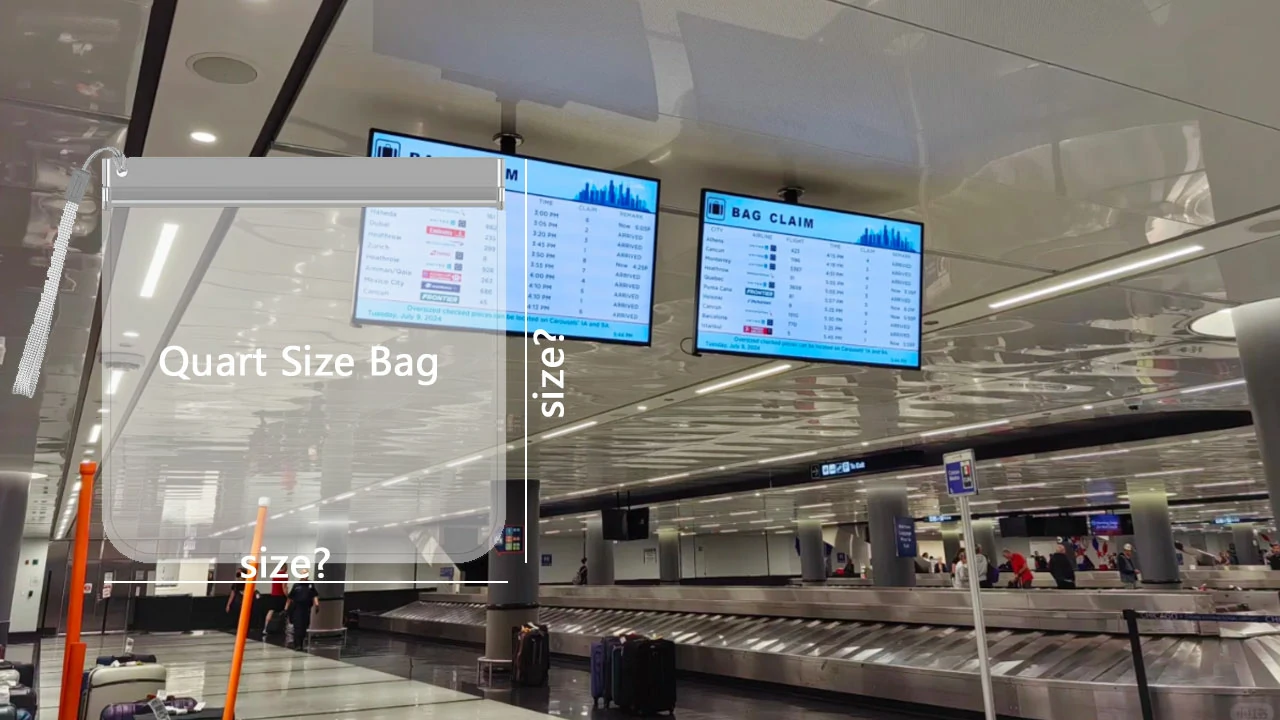
I know that long, technical articles can be a real drag to read, so I’ve prepared a straightforward answer for you here: The maximum capacity for a quart-sized bag that complies with U.S. Transportation Security Administration (TSA) regulations is approximately 1 L. Although there are no exact size requirements, the most common size on the market is about 7 x 8 inches / 17.8 x 20.3 centimeters, and (since reading text can be a bit tiring, I’ve included a table for clarity):
| Capacity | Inches | CM |
| 1 Quart | 7 × 8 in | 17.8 × 20.3 cm |
| 6 × 9 in | 15.2 × 22.9 cm |
Please note that, in addition to the capacity limit of 946 ml (≈ 1 L), the bag must be transparent for easy inspection and sealable. Liquids should then be transferred into 100-ml bottles for storage.
What are the TSA 3-1-1 rules?
Are you confused about the TSA 3-1-1 rule? It’s actually quite easy to understand. Based on the official text released by the TSA, it can be simply explained as follows:
The first “3” equals “3 ounces (3.4 ounces).”
Whether you’re carrying liquid skincare products such as toners or sprays, or semi-liquid items like gels, creams, and other pastes, these liquid-containing items must be packed in a container with a capacity of no more than 3.4 ounces (100 mL).
Please note: It is not sufficient to simply ensure that the volume of the liquid does not exceed 100 mL; the container holding the liquid must not exceed 3.4 ounces in capacity. Take shampoo—one of the most commonly used items—as an example: even if the bottle contains only 50 mL of shampoo, it is not permitted if the bottle’s capacity exceeds 3.4 ounces.
The second “1” means “You should bring one [type of] bag.”
After ensuring that liquid containers do not exceed 3.4 ounces, you can place them in a quart-sized bag with a capacity of 1 liter or less. In addition, the quart-sized bag must be transparent and resealable after items are placed inside.
Note: Although frosted or light-colored transparent bags are not prohibited, fully transparent bags typically clear security screening more quickly. Therefore, to avoid any hold-ups, please recommend fully transparent 1-quart bags to your project clients.
The third “1” means “You may carry only one bag.”
Each person is allowed to carry only one quart-sized bag with a maximum capacity of 1 liter; you cannot carry multiple bags simply because they meet the capacity requirement. When traveling with friends or family, you must place the bag in your own luggage rather than in someone else’s; otherwise, it will be intercepted during security screening.
“Common Types of Items That Comply with TSA Liquid Regulations”
Worried that even though you’re using the right bag, you might still be stopped because your luggage doesn’t comply with the liquid regulations? Here’s a list of common items and their liquid categories for your reference:
| Category | Common Items | Complies with TSA 3-1-1 Rule? |
| Liquids | Toner, mineral water, essential oils, mouthwash | Yes |
| Gels | Hair gel, shower gel, contact lens solution | Yes |
| Pastes / Creams | Toothpaste, face cream, body lotion, hand cream | Yes |
| Aerosol Sprays | Antiperspirant spray, sunscreen spray, styling spray | Yes |
| Spreadable Foods | Honey, jam, peanut butter, sauces | Yes |
| Solids | Solid soap, solid deodorant stick, chocolate, biscuits | Not subject to the 3-1-1 rule; no quart bag required |
| Exempt Special Liquids | Breast milk, baby food, essential prescription medications | Exempt from the 3.4oz volume limit and quart bag requirement |
When a client on your project asks what items they can bring, you can simply send them this form so they can use it as a reference when packing.
What is the official TSA-approved size for a Quart Bag?
As I mentioned in my quick answer, “The TSA does not specify a specific size for the quart-sized bag, but rather sets a capacity limit of 1 quart = 946 ml (≈ 1 L), and the bag must be transparent and resealable.” Now, let me explain this in more detail:
Official TSA Regulations on Quart Bag Size
For containers that meet the 1-quart capacity requirement, common sizes available on the market include 7 × 8 inches (17.8 × 20.3 cm) and 6 × 9 inches (15.2 × 22.9 cm). You may also recommend other sizes to your customers as long as they meet the 1-quart capacity requirement. In addition, I’ve prepared the following for you:
Inches, Centimeters, and Volume Calculator
Inches/cm & Capacity Calculator
Converted Dimensions: 17.8 × 20.3 × 2.5 cm
Calculated Volume: 918 mL
TSA 1-Quart Compliance: Compliant (Within 1-quart limit)
Other Regulations Regarding Quart-Size Bags
Transparent Design:
The bag must be transparent so that airport staff can clearly see its contents during security screening. Although there are no specific regulations regarding transparency, a fully transparent design allows for faster clearance during the 3-1-1 check. If you need to print a brand logo on the bag, we typically place it in the upper-left or lower-right corner and use a small, semi-transparent design to avoid having the logo cover too much of the bag, which could interfere with security screening and prevent your clients from passing through smoothly.
Transparent Materials:
The most common transparent materials are TPU and PVC, but it’s important to note that, as a professional buyer, you should be aware that Europe has very strict environmental compliance restrictions regarding PVC. Therefore, you should choose TPU for your project; it is also the material most commonly used by many brands today.
Resealable:
Bags must be sealed when boarding. If a bag is designed without a seal, it cannot be used—even if it is completely transparent. Sliding lids, snap closures, and zippers are all acceptable for sealing. However, based on feedback from my clients regarding their user experience, the following order of preference has emerged: zippers > sliding lids > snap closures.
Complies with the TSA's official “Quart Bag” category
When your customer needs your help making a decision and you’re unsure about the category of “Quart Bags,” please note: “Quart Bags” simply refers to bags that meet the capacity requirements; there is no specific category. In fact, any cosmetic bag, toiletry bag, or clear storage bag that holds exactly 1 quart and is fully transparent, resealable, and leak-proof qualifies. We’ll now briefly categorize these bags into two types—self-sealing and zipper-seal—for analysis:
Self-sealing Quart Bag
A resealable bag is a bag with a resealable strip at the opening that can be closed by pressing and sliding the flap. For example, individually wrapped dried mangoes are often packaged in this type of resealable bag. Can you picture it now?
Zipper Quart Bag
Transparent TSA-approved zippered bags typically cannot have pinholes or stitching, so a high-frequency heat-sealing process is primarily used to attach the zipper to the bag body, ensuring 100% waterproof and leak-proof performance.
Self-sealing bags vs. zipper bags
Since self-sealing bags use a self-sealing strip, they do not have any zipper holes. However, they lack the ease of opening and closing found in zipper-style bags, and the latches on slide-lid bags are very easy to lose (making it difficult to open the bag once lost). While zipper-style bags are more convenient for repeated opening and closing, they come with higher costs. Therefore, if convenience is the only consideration, then: zipper > self-sealing; if price is the consideration: self-sealing > zipper.
Urgent! What do I do if I don't have a one-quart bag?
DIY with Self-Sealing Bags
If you realize you haven’t packed a Quart Bag while traveling, you can use a plastic bag with a reusable resealable closure in an emergency—as long as it’s self-sealing, transparent, and leak-proof (plastic bags that can only be tied shut won’t work).
How to Pack Liquids from Your Carry-On Luggage into a 1-Quart Bag
Packing the liquids you’ll need for your trip into quart-sized bags in advance will help you get through security quickly and avoid unnecessary hassles. But don’t be intimidated by the task—I’m going to show you exactly how to do it:
Transfer liquids from your carry-on luggage into smaller containers in advance
Before you leave, gather the items you’ll need to bring—such as shampoo, toner, and body lotion (if possible, opt for solid versions with the same benefits)—and transfer them into several small travel-size bottles (preferably clear ones that you can label).
Place the small container filled with liquid into a 1-quart clear bag.
Simply place the filled travel-sized bottles into a 1-quart bag. As I mentioned earlier, there are no specific size restrictions on the inner containers—as long as they fit entirely inside a transparent 1-quart bag, they’re fine.
Arrange in order of frequency of use
When packing, it’s best to place items you use less often at the bottom and those you use frequently at the top. This will reduce the number of times you have to rummage through your luggage while traveling. Of course, if you won’t be using these liquid items during your trip, you can pack them however you like.
Avoid Overloading
No matter how you pack the items, make sure the 1-quart clear bag can close properly and won’t tear.
Common Mistakes When Packing Liquids in Carry-On Luggage
Although the organizing process is very simple, some common mistakes still occur. When your clients ask you for advice on how to organize, be sure to not only share organizing tips but also point out these common mistakes. Avoid complaints resulting from operational errors:
The transparent bag is too large and exceeds the size limit.
Bags that meet the 1-quart capacity requirement are permitted, regardless of how many items you place inside them; however, if your bag exceeds the 1-quart capacity, it is not permitted, even if it is empty.
The capacity meets the requirements, but the material is not transparent.
The TSA explicitly stipulates that quart bags must be transparent. Therefore, when customizing quart bags for your project, you must not request large-scale printed designs; even logos must be semi-transparent and small in size. This will prevent your products from becoming unsellable due to end customers being unable to use them.
Bring several bags that meet the Quart size requirement
One of the “1”s in “3-1-1” indicates that each person may bring only one quart-sized bag onto the plane; even if you have multiple bags that meet the quart-sized bag requirements, you may bring only one onto the plane.
Put it at the bottom of your luggage—it’ll be hard to find during security screening.
When going through security, it’s best to place your Quart bags where they’re easiest to access to avoid having to open all your luggage and rummage through it, which can slow down the screening process.
Liquids Prohibited by the TSA in Carry-On Luggage
You should be aware that not all liquids are allowed on board an airplane (even if they are packed in quart-sized bags in advance). This is to prevent you and your project clients from encountering unnecessary trouble while packing due to a lack of awareness.
List of Prohibited Liquids in Carry-On Luggage
I’ve put together a list of prohibited liquids found in common items that you can download and send directly to your project clients:
| Category | Common Items | Rejection Reason |
| Large-Volume Ordinary Liquids | Large bottled drinking water, fruit juice, red wine, spirits, containers marked >3.4oz | Exceeds the 3.4 oz (100 ml) limit |
| Flammable & Explosive Liquids | Gasoline, alcohol fuel, paint, heavy-duty adhesive remover, flammable pressurized sprays | Classed as hazardous materials |
| High-Pressure Hazardous Aerosols | Industrial rust remover spray, flammable insecticides | Flammable, explosive pressurized canisters |
| Corrosive Liquids | Bleach, drain cleaners, strong-acid cleaning agents | Corrosion hazard |
| Oversized Spreadable Foods | Large jars of jam, big containers of peanut butter, large salad dressing bottles | Container volume >3.4oz |
Just remember: don’t bring any liquids that exceed the capacity limit or that could harm others.
How can we avoid this in advance?
If you have large-volume liquids that you must bring with you, you can pack them securely (to prevent breakage from bumps) and place them in your checked luggage (note that hazardous materials are not allowed). If a solid alternative serves the same purpose as a liquid, try to use the solid version instead. Alternatively, if the items are available at your destination, you can purchase them upon arrival. After all, common liquids in luggage are mainly personal care products, and major brands typically have stores worldwide. As for liquids such as breast milk, infant formula, and medications, you do not need to place them in quart-sized bags, but you must inform security personnel when going through security screening.
Besides the United States, which other countries have regulations similar to those of the TSA?
Although the U.S. Transportation Security Administration’s 3-1-1 rule primarily applies within the United States, other countries have regulations regarding carrying liquids on board that are very similar to those in the U.S. (with only minor differences). Therefore, as long as you comply with the U.S. Transportation Security Administration’s guidelines, you should have no trouble traveling through most countries:
Regulations on Liquids on Airplanes in Countries Around the World
There are many countries and regions around the world, so I’ve listed a few representative airport regulations for your reference:
European Union (Schengen Area airports, including the UK, France, Germany, Italy, Spain, etc.): A limit of one container per item, not exceeding 100 ml, applies. All containers must be placed inside a single transparent, resealable bag with a total capacity not exceeding 1 liter. This aligns with the core logic of TSA regulations; the difference lies in the bag’s capacity limit being 1 liter rather than 1 quart, and the bag must be able to close completely.
Canada: Very similar to the TSA 3-1-1 rule: individual containers must be ≤100 ml, all must be placed in a clear, resealable bag, and only one bag per person is allowed.
Australia and New Zealand: Individual containers must not exceed 100 ml, and all must be placed in a clear, resealable bag; liquids purchased at airport duty-free shops must retain their original packaging and proof of purchase and are permitted only during transit.
Southeast Asia (Singapore, Thailand, Malaysia): The same “single container ≤ 100 ml + clear, resealable bag” rule applies. Note that some Southeast Asian airports will verify the bag size on-site, and liquids will be re-inspected during transit security screening.
How to Check in Advance When Traveling by Air with Liquids
The easiest way is to visit the official websites of the security agencies in each destination country in advance, search for information on liquid luggage regulations, and then check against the items you’re carrying. I’ve put together a checklist with “Yes/No” options that you can use directly when working with project clients:
| Checklist Item | Check: Yes / No |
| For liquids, gels, pastes and aerosols: Is the labeled container capacity ≤100ml (3.4oz)? | Yes / No |
| Are all compliant small containers placed inside a single transparent, reusable and fully resealable bag? | Yes / No |
| Does the resealable bag meet departure security standards (US 1 quart / EU 1L for declaration)? | Yes / No |
| Contents inside the bag are fully visible without opening the pouch. | Yes / No |
| Do you carry exempt items (breast milk / baby food / essential prescription medications, with supporting documents ready)? | Yes / No |
| Are any items classified as prohibited dangerous goods for air travel (flammable sprays, strong acids, paint, fuels, etc.)? | Yes / No |
| If your flight has transfers: Have you verified liquid rules for the transit country/region? | Yes / No |
| For liquids bought at duty-free shops during transit: Are original sealed packaging & purchase receipts retained? | Yes / No |
| Confirm your full itinerary: Are there conflicting liquid regulations across origin, transit and destination? | Yes / No |
If you are told that you cannot bring an item through customs, you can stay home ahead of time. If you purchased a liquid item at a layover location and are told you cannot carry it but it is very valuable, you can try sending it home via international shipping.
Where can I find the latest U.S. TSA regulations and updates?
The official website of the U.S. Transportation Security Administration (TSA) is https://www.tsa.gov. Once you’re on the official website, simply search for “3-1-1” in the search bar in the upper-right corner to view the latest information. If you don’t see the search bar, you can go directly to https://search.usa.gov/search?affiliate=tsa.gov&query=3-1-1 to immediately view all information related to “3-1-1.”
Summary
The U.S. Transportation Security Administration (TSA) 3-1-1 rule and “quart bag” do not refer to a specific type or size of bag, but rather set capacity restrictions. As long as the bags your project clients carry meet the requirements—1 quart capacity, fully transparent, resealable, and leak-proof—they qualify as acceptable “quart bags.” If you need to source compliant quart-sized bags for your project, we at 367 Quart Bag Manufacturer can provide travel bags, toiletry bags, makeup bags, and storage bags that meet all requirements. We can also print your brand logo on them, allowing your project clients to carry the necessary liquids onboard in compliance with the quart bag capacity regulations while providing ongoing brand exposure.